_edited.png)


EUROPE & UK
SPAIN
IBEX (4 SPECIES)
Hunters have access to a cornucopia of big game species in Spain and among the most sought after are its 4 ibex species. The central-west Gredos Mountains are home to the Gredos Ibex, and the Beceite are located in the northeastern part of the country. The Sierra Nevada and Tejada-Almijara ranges in the south are home to the Southwestern Ibex, and the smallest of the four, the Rhonda, is found in its namesake home, the Rhonda Mountains.
Each of the 4 ibex displays unique coloration and horn configuration. Each hunt should be considered a mountain hunt worthy of preparation and fitness to move through territory and the ability to glass for extended periods.


CHAMOIS (2 SPECIES)
Pyrenean chamois are larger than its Cantabrian counterpart, but each is a respected trophy in high demand by Capra collectors who simply enjoy the challenge of mountain hunting for wary animals. The prime hunting season runs from approximately October through February. Both species have extraordinary eyesight and can disappear quickly. We use the spot and stalk method, and hunters will need a reasonable level of fitness to reach them.
SPANISH (IBERIAN) RED DEER
This majestic species, although smaller in overall stature (180-220 lbs.) than red deer in central and eastern Europe, New Zealand, and Argentina, the Iberian red deer are grand in their own right. And their uniqueness warranted a distinct trophy classification in the record books. They can exhibit characteristic cupping at the top of their main beams and overall are usually symmetrical and can sport 10 points or more per side.
The season is long – from September through February. The peak of the “roar” historically begins in November and lasts to the end of December. They are more active, visible and locatable as their roars sound out from beautiful landscape.

IBERIAN MOUFLON
Sheep hunters gravitate to Spain for the bold contrasting colors on this beautiful sheep that can produce out-sized horns for their body size. They are found in varied terrain ranging from rocky slopes to forested areas. They can be hunted almost every month of the year except July and August and are of course combinable with many other species that overlap their respective prime time hunting periods.
FALLOW DEER
In the “hot zone” of overlapping prime time hunting seasons, September through February, the attractively palmated and colored fallow bucks offer exciting hunting.
The peak of the rut is November and December. They are vocal and wildly aggressive in protecting their harems. They will be found in the woodland and foothills for the spot and stalk hunter.
ROEBUCK
This small deer is the most popular deer species in Spain and generally across all of Europe. Despite its diminutive body and horse size, hunters recognize them as a coveted trophy for their attractive appearance and intrinsic wariness.
We hunt them in many places in Spain, but the north central and northeastern areas are where most hunting is concentrated, usually in combination with hunts for other species. Spotting and stalking is the prime method of hunting in and around lowland forest meadows and grasslands. Blinds and high seats are also frequently used. They are most active in mornings and at dusk during prime months of April through mid-June.
BARBARY SHEEP
This sheep-goat genetic blend, originating from the Atlas Mountains of north Africa, are best huntable from October through February. Their attractiveness lies in their golden sickle-shaped horns and long chaps. The hunts in Spain for this trophy animal should not be confused with game ranch hunting in Texas. Like aoudad found anywhere, they have adapted to conditions that mimic their natural home and always present a classic mountain hunting challenge.


AUSTRIA
ALPINE IBEX
Widely considered Europe’s elite species, the Alpine ibex is found in the high mountain estates governed by strict game management practices that support hunting.
Mounts of this iconic species are not frequently encountered in trophy rooms because hunting is limited and expensive relative to the cost of hunting most other ibex species. However, when budget allows, hunting the grand alps with methods steeped in tradition will deliver untold rewards.
ALPINE CHAMOIS
Despite their diminutive size, Chamois are revered for their agility. They can be hunted in combination with the elusive Alpine ibex and found in high meadows looking out warily from the craggy outcroppings of densely wooded forests.
CROATIA
EUROPEAN BROWN BEAR
Among all destinations that support traditional hunting and non-hunting touring, Croatia ranks as one of the best combo adventures. The biggest attraction however is the brown bear located inland from the beautiful Adriatic. Dense forests produce one of hunting’s most prized trophies for species collectors and the method of hunting them is organized by an unwavering code of tradition. They are hunted in the spring and fall seasons.
EUROPEAN MOUFLON, BALKAN CHAMOIS, DALMATION SHEEP, AXIS DEER, & HYBRID KRI-KRI IBEX
These desirable species in the coastal region and islands provide opportunities for combination hunts with the premier species, brown bear. We will explain the possible combinations depending on the timing of your visit. And even if you don’t hunt brown bears, Croatia is worth the trip for these other species.
HUNGARY
RED DEER
The Danube River Valley is ground zero for the European red deer. Genetics from the region define this species, which is why Hungary was utilized as a go-to source for transplants when starting up herds in other countries over generations.
Hunting is a managed endeavor steeped in tradition and rules. A combination of spot and stalk and high seat methods are utilized depending on conditions and terrain. Cost scales as a function of trophy size. And Hungary is another choice destination for adding on a cultural sightseeing adventure.
ROEBUCK
Dense forests and meadows yield some of Europe’s biggest roebuck. Hungary attracts international hunters and roebuck specialists for its trophy quality potential alone.
EUROPEAN MOUFLON
Hungary produces exceptional mouflons annually. Forested estates manage them for trophy quality production. Professional guides pride themselves in creating opportunities for selective trophy hunting for stark coloration and out-sized horns relative to body size of this beautiful sheep.
MACEDONIA
BALKAN CHAMOIS, KRI-KRI IBEX, EUROPEAN MOUFLON
With such a steeped hunting tradition, Macedonia has increasingly appeared on the radar of destination hunters. Varied lush and protective terrain and careful wildlife stewardship of game-rich hunting reserves has ensured authentic hunting. If any of these species appears on one’s list of must-have trophies, Macedonia is the go-to destination.
ROMANIA
EUROPEAN RED STAG
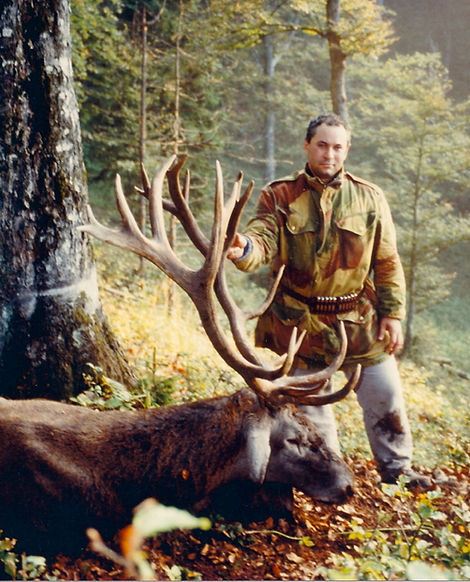
When Romania opened for licensed hunting after the fall of communist dictator Ceausescu, senior members of our team were the first to hunt what historically were some of the finest wild and free trophy red stags. Previously, Ceausescu had a strong hold over the country’s wildlife, often helicoptering in alone or with bureaucrats he wanted to entertain to shoot big stags and bears that had been sighted by the forestry custodians. His hunting museum featuring over 200 of the world’s biggest red stags and brown bears ever taken is testimony to that.
The Carpathian Mountains remain unspoiled and wild, and they produce some great red stags annually. Conservation practices have helped preserve the tradition for the future. The roars heard from the wooded foothills during September will provide a thrilling spot and stalk hunt and the opportunity to experience it as a tradition steeped in the mystique. Romania is the center of gravity of the red deer’s origin.
EUROPEAN BROWN BEAR
We hunt the magnificent bears in the Spring (April and May) and fall (September to October). These are the prime months to hunt one of Romania's most noble of the country’s game species. With bear hunting recently resumed to a population average, the hunt offers the prospects of 100% success on bears of exceptional C.I.C. trophy-class ranking.
CARPATHIAN CHAMOIS
Home to the largest of the chamois species, the stunning landscapes of the Carpathian Mountains create an authentic mountain hunting experience. They are as worthy a trophy as any mountain species and thrive in good numbers due to enhanced conservation strategies. Hunting them requires physical conditioning that enables ascent into the wooded foothills and rocky outcroppings that can range up to about 8,000 feet.
U.K.
SCOTTISH HIGHLAND STAG
Western Scotland has been the go-to destination for classic hunts for this noble member of the deer family, the "Scottish Red". The hunting experience is classic in every sense of the spot and stalk method of hunting, and trophies taken in such historic glens and hills seem rightfully placed on the walls of castles, manor homes, and trophy rooms worldwide.
Sika deer is a prized and challenging option on a Highland stag hunt. Hunts for both species begin August and last through mid and October is prime time for both. And a hunting trip to Scotland presents an opportunity for sightseeing and other sporting activities, which we can easily arrange.
ROEBUCK
While roebuck in good numbers can be hunted in the northeast Scotland, England offers more widespread distribution and bigger trophies on average. Like Roebuck hunting elsewhere, the spring months are the most productive in low areas of vegetation and farmland.
Chinese Water Deer and Muntjac
These interesting species are often hunted in combination close to London and in the Cotswolds and Oxfordshire.
The Chinese water deer do not sport antlers but “fangs” instead. Originating in China and Korea, they were first transplanted into the Woburn Park estate in the late 1800s. Since then, they have taken hold in various parts of southern England and actually exist in the wild. November through March is prime season.
The Muntjac is the oldest known deer with primitive characteristics of visible upper canines. They also originated in China. There is no closed season, and they are found in low rolling grasslands and wooded areas, sometimes very close to picturesque villages.
PANTHEON HUNTERS+ CAPRINAE SAFARIS
Pantheon Hunters® and Caprinae Safaris have joined forces to serve hunters with exceptional worldwide capabilities, actionable insights, and executional know-how.
Caprinae has organized big game hunting trips in 18 different destinations for over 50 different species and subspecies, specializing mainly in Ovis and Capra species. The company also offers a large variety of deer and bear hunts across Asia and Europe.

