_edited.png)


Inspirational Pantheons: Vol. 2

Updated: Jan 4
Teddy Roosevelt

Roosevelt's legacy in hunting is thus dual; he was both a prolific hunter and a pioneer in conservation, understanding that without sustainable practices, future generations would lose the opportunity to experience the wilderness he so loved. His approach has had a lasting impact on how hunting is perceived and regulated in the U.S.
Early Life and Hunting
Youth and College: Teddy Roosevelt grew up interested in natural history and hunting. Even as a child, he spent a lot of time collecting specimens for his mini-museum. His interest in hunting intensified during his college years at Harvard, where he studied natural history and engaged in hunting trips.
Dakota Territory: After the tragic loss of his first wife and mother on the same day in 1884, Roosevelt retreated to the Badlands of Dakota Territory. Here, he lived the life of a rancher and hunter, which profoundly shaped his views on conservation. His experiences hunting big game like bison, elk, and bear in this rugged terrain were formative, teaching him about the fragility and beauty of the natural world.
Hunting as President
African Safari: Perhaps his most famous hunting expedition occurred after his presidency in 1909-1910, when he embarked on a year-long safari in Africa. This trip was sponsored by the Smithsonian Institution to collect specimens for the National Museum of Natural History.
He hunted a wide variety of animals, including lion, elephant, and Cape buffalo, but also collected thousands of specimens for scientific study, which was one of the largest collections of its kind at the time.

South America: In 1913-1914, Roosevelt explored the Amazon Basin, including the then-uncharted River of Doubt (later named Rio Roosevelt after him). Though this expedition was more about exploration, hunting was part of the survival strategy and scientific documentation in the dense jungle.
Conservation Legacy
Advocacy for Conservation: Roosevelt's experiences as a hunter greatly influenced his conservation policies. He was a key figure in establishing the United States Forest Service, and during his presidency, he significantly expanded the national forests and established numerous national parks, wildlife refuges, and monuments. His approach was often described as "wise use" or "conservation" rather than preservation, where hunting could coexist with preservation if managed correctly.
Boone and Crockett Club: In 1887, Roosevelt co-founded the Boone and Crockett Club with fellow hunters, which was instrumental in promoting ethical hunting practices, wildlife conservation, and habitat protection. This club played a significant role in lobbying for laws that would protect wildlife from extinction.
Ethical Hunting

Roosevelt was an advocate for fair chase, a principle that promotes ethical hunting practices where the
animal has a fair chance of escaping. He believed in hunting not just for sport but for the management of wildlife populations and the preservation of species' habitats. His writings, including books like "The Wilderness Hunter" and "Hunting Trips of a Ranchman," reflect his deep respect for nature, detailing his hunting adventures while weaving in lessons on conservation. Ranchman," reflect his deep respect for nature, detailing his hunting adventures while weaving in lessons on conservation.

Robert (Bob) M. Lee (1927-2016)

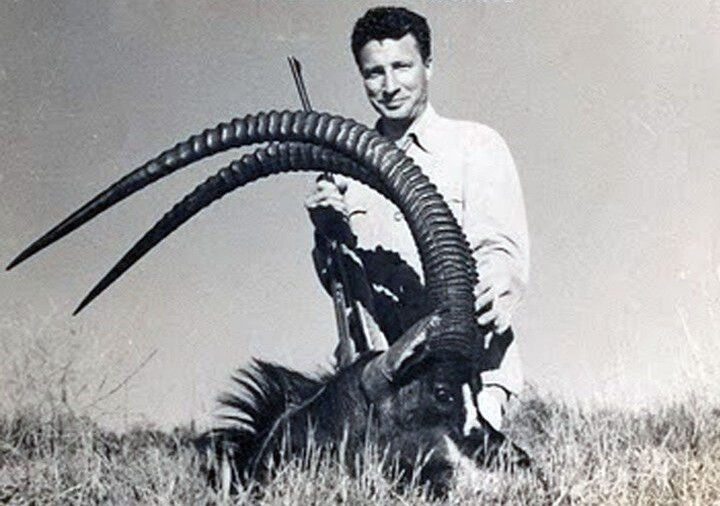
Early Life and Interest in Hunting: Born in Woodmere, Long Island, New York, Bob Lee developed a passion for hunting and the outdoors early in life. He was influenced by his parents and corresponded with notable outdoor writers like Jack O'Connor and Elmer Keith as a boy.
Safari Outfitting and Exploration: Lee was not only a hunter but also an outfitter, safari guide, and explorer. Lee was one of the first Americans to have a hunting concession in Africa (Lee Expeditions, Ltd.) and the first PH to open Portuguese Angola to foreign hunters. He led numerous hunts with high-profile figures like H.I.H. Prince Abdorreza, the brother of the Shah of Iran.
Between 1980 and 1984, after six years of negotiations with the government of the People's Republic of China, Mr. Lee became the first Westerner to gain access to and lead three scientific expeditions into the rugged Tien Shan mountains and Chinese Pamirs - known as "The Roof of the World" - where he rediscovered the fabled Marco Polo sheep, Ovis ammon poli, on Chinese soil and documented their migration. He was successful in convincing the Xinjiang (Shin-jiang) Provincial government to institute protection for many of its wonderful species and his reports were responsible for the creation of the Tashgorgan Wildlife Reserve in the Pamirs. His explorations took him to exotic places like Nepal, India, and China.

Conservation Efforts: Beyond hunting, Lee was a

passionate conservationist. His efforts in Angola included designing the first ecologically sound wildlife management program with the Portuguese Provincial government to counteract poaching. While living in Angola in the 1960s, he was instrumental in obtaining government protection for lion, cheetah, black rhino and their habitats. He designed the first ecologically sound wildlife management program in Africa with the then Portuguese Provincial government (Angola) to counteract the decimation of the big-game population by over-hunting and poaching. There was more big game there when he left than when he arrived. This was a cause he championed around the world during his lifetime.

Hunting World, Inc.: In 1965, Lee founded Hunting World, Inc., initially to design equipment for African safaris, which later expanded into luxury luggage, clothing, and accessories. This brand reflected his practical experience in hunting and outdoor life, emphasizing durability and functionality.
Hunting World grew into a global brand with 100+ retail points across North America, Europe, and Asia. It was the first company to take the aesthetic of safari — canvas, leather, rugged elegance — and turn it into a luxury lifestyle brand. It predated Filson’s resurgence, Orvis’s expansion, and the modern “heritage” movement by decades. Lee essentially invented safari chic.
Literary Contribution: Robert M. Lee authored several books on hunting and firearms, including "Safari Today" and "China Safari" and he co-authored five-volume miniature series, "The Art of the Gun." His writings often highlighted his experiences and the cultural aspects of hunting around the world. He authored “China Safari: An American Explorer in the Forbidden Pamirs” to chronicle his expeditions into China.
Legacy and Recognition: Throughout his life, Lee was recognized for his contributions to hunting and conservation. He received the C.J. McElroy Award from Safari Club International in 1999. His legacy includes significant donations to conservation efforts through the Robert M. Lee Foundation, which supports international conservation and environmental organizations.
Hector Cuellar

Hector is recognized as an exceptionally accomplished mountain hunter, particularly for his extensive collection of species and subspecies from around the world. These accomplishments underline a lifelong commitment to mountain hunting, not just as a form of adventure but as a testament to human endurance, skill, and passion for wildlife. His story also highlights the extreme lengths to which he has gone to complete his hunting achievements, even in the face of physical limitations as he continued to hunt into his 80s.

Extensive Species Collection: Hector has hunted over 350 species and subspecies globally, which is one of the highest numbers among mountain hunters. This has led to his recognition as the 2014 Ovis recipient, a prestigious award by the Grand Slam Club/Ovis.
Awards and Recognition: He received the Weatherby Award in 1986, which is awarded for significant contributions to the field of hunting. In 2013, he was honored with the Legend Award at the Hunter & Outfitter Convention in Reno, Nevada, acknowledging his lifetime dedication to hunting.
Endurance and Dedication: Despite undergoing a double knee replacement at the age of 80 in 2011, Hector continued his hunting pursuits. Remarkably, he traveled to the Caucasus Mountains to hunt the mid-Caucasian tur, one of the last species he needed for his collection. Dissatisfied with the size of his first catch, he returned in 2012 at 81 to hunt a larger specimen, showcasing his relentless pursuit of his passion.
We always admired Hector because he always carried his gun regardless of the difficulty of the hunt. And he was known by all as a genuinely good man.
Frederick Courteney Selous (1851-1917)

Frederick Courteney Selous was a prominent
British explorer, officer, hunter, and conservationist, renowned for his adventures in Southeast Africa. His contributions to exploration, literature, and conservation are recognized through various tributes, including namesakes in wildlife and the military (like the Selous Scouts in Rhodesia).
His life story reflects a blend of adventure, colonial history, and early conservationist efforts, encapsulating a significant era in African exploration and the complexities of colonial interactions. He was a pioneer and archetypal white hunter of African big game safari hunting.

Early Life: Born on December 31, 1851, in London, Selous was the son of a wealthy and educated family; his father was the Chairman of the London Stock Exchange, and his mother was a published poet. From a young age, Selous was captivated by tales of exploration, particularly those of David Livingstone, which fueled his ambition to become a hunter in Africa.
Exploration and Hunting: He traveled to South Africa in 1871 at the age of 19, where he spent much of his early adulthood exploring and hunting. His adventures are documented in books like "A Hunter's Wanderings in Africa" and "Travel and Adventure in South-East Africa." Selous was known for his contributions to geographical knowledge, receiving the Founder's Medal from the Royal Geographical Society in 1892.

Military Service: During the First World War, despite his age (he was 64), Selous rejoined the British Army and served in the East African Campaign against German forces. He was promoted to Captain in the 25th (Frontiersmen) Battalion, Royal Fusiliers, and awarded the Distinguished Service Order (DSO) for his gallantry. He was killed in action on January 4, 1917, by a German sniper in what is now Tanzania.
Conservation and Legacy: Although primarily known as a hunter, Selous was also an early advocate for conservation. He warned about the unsustainable hunting practices that threatened species like the elephant. His legacy includes the Selous Game Reserve in Tanzania, now known as Nyerere National Park, which was named in his honor. This reserve is one of the largest protected areas in Africa, highlighting his influence on conservation efforts. In 1909, Selous co-founded the Shikar Club, a big-game hunters' association with two British Army Captains, Charles Edward Radclyffe and P.B. Vanderbyl and they regularly met at the Savoy Hotel, London. The Club’s first President was the Earl of Lonsdale; another founding member was the Selous biographer John Millais.
Cultural Impact: Selous inspired the fictional character Allan Quatermain by H. Rider Haggard. His life and exploits have been documented in numerous biographies and his own travel accounts, contributing significantly to the literature of exploration and big-game hunting.

Personal Life: Selous married Gladys Maddy in 1894, and they had three sons. However, he also had children with African women according to tribal customs, showcasing a more complex personal life than often acknowledged in traditional histories.
Selous’s first elephant seemed indestructible; it took 35 rounds from his ‘two-grooved rifle’, and 40 more from his ‘Dutch six-pounder’ before the animal began ‘to evince signs of a dilapidated constitution.’ He and his native cohort, the indispensable bearers and trackers, hacked out the tusks of about 57 pounds each. That night they feasted on the elephant's heart, a great delicacy, roasted on a forked stick above the campfire.
He killed 11 more elephants in his first season, in one instance bagging a group of three in one go. His first season’s take amounted to 400 pounds of ivory. He bought another 1278 from native traders and sold it all, clearing £300, not quite enough to cover his father’s investment, but he was not yet 21. Over his first three seasons (1872-74), he shot 78 elephants.

In a posthumous tribute to Fred Selous, Theodore Roosevelt wrote: ‘I greatly valued his friendship; I mourn his loss; yet I feel that in death, as in life, he was to be envied.’ Selous was shot in the head aged 64, while soldiering by the banks of the Rufiji (Tanzania) during First World War skirmishes between German and British colonialists.
Contact us today to start planning your next expedition!