_edited.png)


Keepers of the Wind – Navigating the Myth and Reality of Argali Hunting in Mongolia

Updated: Mar 11

Imagine a sensation that defines a threshold moment. The wind moves past you. Mountains stop being terrain and become something closer to a presence. You realize you’re no longer just in the Altai—you’re being absorbed by it.
Up where air tastes of stone and sky, the hunt takes on a strange clarity. For a moment, you’re not a hunter, not a visitor, not even a man with a rifle—you’re a spirit scouting its own destiny.

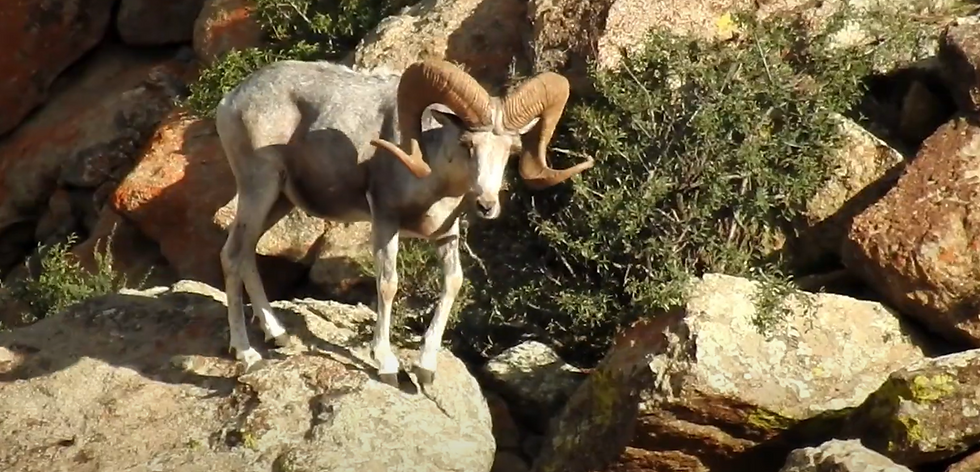
When you finally see him — an old ram standing on a skyline carved by time — he doesn’t look like an animal. He looks like a symbol. A guardian. A creature that has stepped out of the Bronze Age and into your crosshairs just long enough signal the rarity of the moment.
When the shot breaks, it feels less like pulling a trigger and more like snapping back into your own skin. You feel the enormity of what you’ve just done.

And as you walk toward the fallen ram, the out‑of‑body sensation doesn’t vanish — it settles into you like a secret. A private myth. A moment when the boundary between man and mountain blurred, and you stepped briefly into a realm where time moves differently.
This is the mythic profile of the Argali — reverent, elemental, and shaped for a canon that outlives any single hunt. The Argali is not a quarry. He’s a mountain deity.
Origin in the World Before Memory
Long before riders crossed the steppes and long before the first blade was hammered into shape, the Altai already knew the Argali. He was there when the mountains were still cooling.
The shamans of the early clans believed the Argali was not an animal at all, but a messenger between realms — a creature whose horns held the spiral of creation and whose hooves touched both earth and the sky.
To hunt him was not an act of taking. It was an act of entering the mythic order.
The Argali’s horns are not merely trophies. They are glyphs — spirals that echo the turning of seasons, the coiling of storms, the looping of time itself.
To the old clans, a great ram’s horns were a map of the heavens, a record of winters surviving, a symbol of rightful kingship, and a test of a man’s spiritual weight.

Even today, when a hunter first sees a mature Argali standing on a skyline, the moment feels staged by something older than chance. His stance suggests he has been waiting for centuries.
Even the way he turns his head feels ceremonial, as if acknowledging your arrival in his realm. Hunters who have taken great rams often describe the shot as the instant they “fell back into themselves.”
The Place of the Argali in the Pantheon
Among the great game of Asia, the Argali stands alone. All four Argali species (High Altai, Northen, Hangai and Gobi) are the high priests of the world’s mountains. Nothing soft survives in their vertical kingdom. The Argali is not approached. He is earned.
The State of the Now and Call to Action
Here is the actual, on‑the‑ground state of Argali hunting in Mongolia today, distilled into a Pantheon Hunters‑grade field brief—clear, unsentimental, and grounded in the most recent available information.
Population & Conservation Status
Data quality is inconsistent.
The Argali remains a species whose management is governed more by tradition, bureaucracy, and political inertia than by modern wildlife science.
Argali hunting is still possible, still prestigious, and still tightly controlled—but the biological foundation beneath the quota system is softer than it should be.
The Argali is managed from the capital, not the mountain. The people who live with the sheep have little stake in their survival.
Field Conditions for Hunters Today
Operationally, the hunt is still authentic: altitude, distance, wind, and the mountain’s indifference remain unchanged.
Modern Argali hunts remain logistically demanding but are well‑supported by experienced outfitters.
Camps are typically gers — sturdy, traditional Mongolian structures
Hunts occur across Altai, Hangai, and Gobi ranges, each with distinct subspecies and terrain.
o High, broken shale ridges in the Altai
o Rolling steppe‑mountain transitions in Hangai
o Desert‑mountain interfaces in the Gobi
Hunters still rely heavily on local spotters and guides; language barriers remain common.
Pantheon Hunters’ Verdict
Argali hunting in Mongolia endures — but it endures on the strength of tradition, prestige, and the resilience of the mountains themselves, not on the strength of modern wildlife science. The future of hunting has to be considered uncertain.

As with everything in life, not all things are created equally. This applies to the hunting world in spades. Whether it be Mongolia, British Columbia, Zimbabwe, or Kansas, hunting areas differ in population density and trophy potential. This likely seems an obvious and trite thing to say, but it carries weight today – and is more hyper-relevant than ever before.
Western Mongolia is recovering from back-to-back severe winters within the last 5 years. This High Altai and Northern Altai territory suffered material die-offs, especially older rams. The upshot is that there are positive signs of recovery.
But many of the out-sized trophy pictures appearing on Instagram and Facebook in 2025-2026 have been taken well before the winters took their toll. This sets an unrealistic expectation. For those who define success in inches, a 60-inch High Altai ram is an outlier today, a gift from the heavens. 55-58 inches is more realistic.
I will note editorially here that horn length and mass are not the only criteria of trophy quality. A ram of 55-58 inches can be a very compelling, imposing trophy. I’ll save this discussion for another post.
And, granted, there are a few outstanding trophies that have been taken recently, but few is the operative word. And the overall average size is less in length and mass than what defined a trophy in the past.
The same can be said for Gobi Argali. Harsh winters and the expansion of mining in the desert have disturbed their timeless patterns.
The Way Forward
The discretionary finances and goals of elite hunters have created enormous competition and pressure on the system. Market demand is exceedingly high. Expectations are elevated.
Consequently, due diligence thresholds in the hunt selection process must be much higher in order to protect money, time, and emotion. A hunter must find someone with behind-the-scenes knowledge and operational capabilities to trust for advice and the ability to conduct their hunt precisely aligned to properly set expectations.
A general model of the Mongolian hunting industry is to classify Argali hunting areas into standard and premium areas. Permit prices paid at government auctions (and therefore total hunt prices) correlate to historic production and present-day potential of these two classes of hunting area. So, a hunter’s trophy class objective in the pre-booking process is very important for determining which permits the outfitter will attempt to win at auction.

Secondly, the outfitter will offer guidance on defining trophy objectives, which as stated above, has a bearing on the permits to be bid on at auction. So, how do you go about defining your trophy size objectives ahead of the auction?
We developed a simple tool called 10 Rams. As the name implies, we provide pictures of 10 High Altai rams and ask the hunter to pick 2-4 of the rams that they like and would be happy to take. In a follow-up discussion, we reveal the actual measurements of the rams chosen. Invariably there are some major surprises.
In many cases, they pick rams far less than their go-in desire of 60 inches because of so many other positive characteristics that can project a ram as big and beautiful.

This has been a good way to help hunters define what success looks like, which in turn is instructive to the outfitter for what to bid on at auction, both of which yield the hunt cost to consider.
The real work begins after winning the bid. Elite outfitters will not only scout the territory continuously like hell in the run-up to the hunt, but they will also have been scouting year-round with monthly scouting reports issued to them by the locals. Also, the structure of pricing programs for premium areas could provide both an extra incentive for the locals to find out-sized trophies and partial refunds to the hunter if they don’t succeed. We have innovated such a program for the High Altai and Northern Altai hunts. It's a win-win for hunters and locals.
Overall, Mongolian Argali hunting should not be considered a commodity reflecting abundance in any sense of the word. These noble sheep deserve rarity status that should be underpinned with a sense of urgency. If you have the financial means, prioritize Mongolian Argali.
The bottom line is that the big ones are still out there if one knows where to find them and how best to optimize a complex array of factors affecting success. This is our job. We live for surgical precision in hunt strategies. We know where to hunt you because we are constantly monitoring leading indicators of change – looking at data, leveraging high-trust relationships in Mongolia, and scouting with our own eyes and boots on the ground.
The truth is not complicated. We welcome calls or emails for more insights.

