_edited.png)


Abercrombie & Fitch and the Era of Griffin & Howe (1930–1976). What Died and What Survived.

Updated: Sep 20

Abercrombie & Fitch, founded in 1892, evolved to be the social center of American sporting and safari gun culture.
“I’m going to Tanganyika for lion, buffalo, and plains game.”
“You’ll need a .30‑06, a .375 H&H, and a .470 double. Let’s begin.”
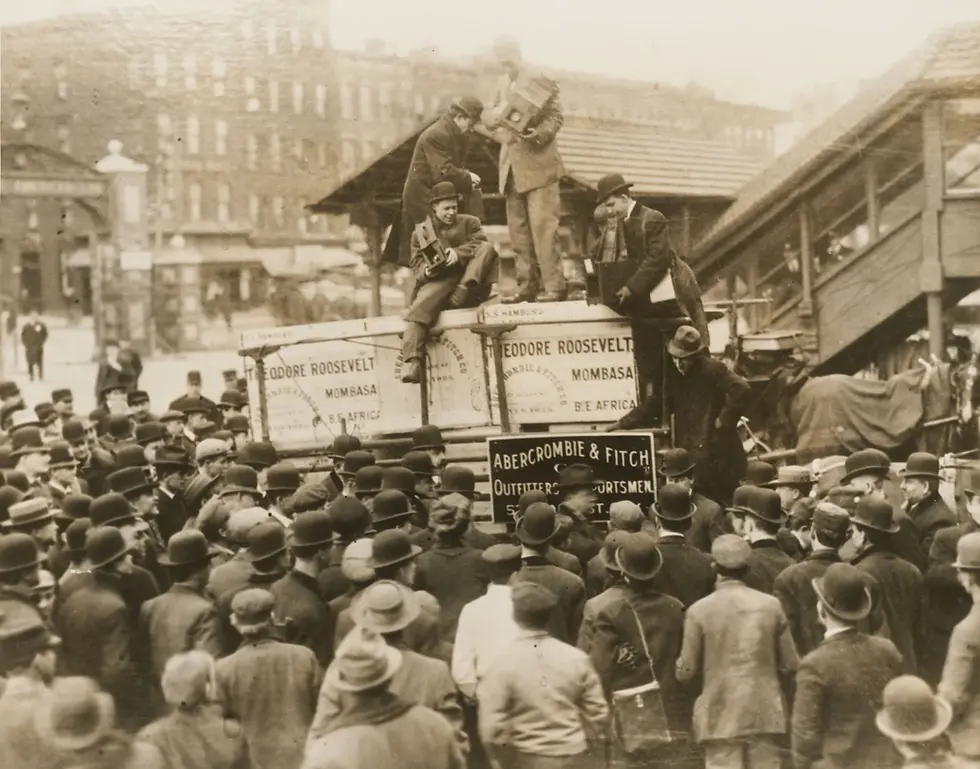
A&F was importing sporting guns and rifles from Holland & Holland, Westley Richards, Rigby, Purdey, Boss, Francotte, Krieghoff, and Merkel among others. But A&F didn’t just sell safari rifles — they booked hunts, arranged travel, and outfitted expeditions. It famously outfitted Teddy Roosevelt’s landmark safari, the Smithsonian Expedition, between 1909 and 1910.
A&F’S GAME CHANGING STRATEGY – THE PURCHASE OF GRIFFIN & HOWE
In 1930, Abercrombie & Fitch purchased Griffin & Howe, which became the gunroom inside America’s most famous outfitter for the next 45 years. The Abercrombie & Fitch–Era of 1930–1976 was the period when G&H becomes the gunroom for America’s elite. Griffin & Howe was the American expression of the London Best ethos, and A&F was the stage on which that ethos was displayed. The acquisition was a very strategic move.

This era marked one of the richest chapters in American sporting history, and it sits inside a much larger ecosystem of elite retailers who were importing, commissioning, and selling the finest firearms in the world. This was the golden age of the American sporting emporium — a time when a gentleman could walk into a Manhattan or Chicago showroom and order a Rigby .275, a Westley Richards .318, a G&H Springfield, a Fox HE Super, and a full safari kit in one afternoon.
Griffin & Howe blended old‑world craftsmanship with American innovation. Presidents, generals, writers, and the great safari hunters of the 20th century carried their rifles.

Origins (1910–1922): Seymour Griffin, the Cabinetmaker Who Started It All
· 1910: Seymour Griffin, a New York City cabinetmaker, reads Theodore Roosevelt’s African Game Trails and becomes fascinated with the Springfield rifle Roosevelt used on safari.
· Dissatisfied with the military stock on his own M1903 Springfield, he buys a $5 French walnut blank from Von Lengerke & Detmold and restocks the rifle himself.
· The result is so good that a friend buys it immediately — and Griffin begins building custom Springfield sporters in his spare time.
· His distinctive stocks (Schnabel fore-ends, hand checkering, and a unique angled cut near the bolt port) have become well known among affluent hunters.
The Partnership (1921–1923): Griffin Meets James V. Howe
· Col. Townsend Whelen, then commanding Frankford Arsenal and a major figure in American rifle making, hears of Griffin’s work.
· Whelen introduces Griffin to James Virgil Howe, the foreman of the Frankford Arsenal machine shop and a master metalworker.
· Howe had just collaborated with Whelen on the creation of the .35 Whelen cartridge.
· The three men meet with financiers in April 1923 and secure backing for a new custom gun making firm.
· June 1, 1923: Griffin & Howe officially opens in New York City.
· Howe leaves later that year for Hoffman Arms, but his name remains on the marque.
1920s–1930s: Innovation and Expansion
· .350 G&H Magnum — a proprietary cartridge developed by the firm. Long forgotten but one of the best medium-bore cartridges ever made.
· 1927 G&H Side Mount — a detachable side‑lever scope mount allowing removal and replacement without loss of zero. This becomes one of the most influential American scope mounts ever designed.
Business Growth

Griffin assembles a team of American and European master gunsmiths. The company becomes known for:
o Custom Springfield sporters
o Custom Mauser sporters
o High‑grade bolt rifles and shotguns
o Outfitting services (optics, tents, clothing)
The Great Depression
· Sales collapse in 1929, but the firm survives by seeking new financial backing.
· Financial stability accelerates when G&H is acquired by A&F in 1930.
Mid‑Century Prestige
Jack O’Connor famously called G&H “the Holland & Holland of the United States.” Griffin & Howe becomes the premier American custom rifle shop, building rifles for:
· Ernest Hemingway
· Robert Ruark
· Dwight D. Eisenhower
· Norman Schwarzkopf
· Clark Gable
· Gary Cooper
The most collectible Griffin & Howe rifles were early Springfield sporters (1923–1930, Pre–A&F Acquisition). These are the crown jewels because they were built when Seymour Griffin himself was shaping stocks by hand, James V. Howe’s metalwork influence was still visible. And extremely low production numbers. Overall, they defined pure “American Classic” lines before the Abercrombie & Fitch era standardized the style.

The single most collectible G&H rifle, in terms of pure collector gravity was Hemingway’s Griffin & Howe Springfield. It is the American equivalent of a Rigby .275 owned by Bell or a .318 owned by Selous — a rifle tied to a mythic figure who shaped the safari narrative.

When A&F purchased Griffin & Howe in 1930, they didn’t just buy a gunmaker — they bought prestige, craftsmanship, and a ready-made clientele of wealthy sportsmen. A&F was already the premier outfitter for expeditions, safaris, and big‑game travel. G&H became the crown jewel of their gunroom.
What defined the A&F–G&H Era is the company was fully integrated outfitter. It was a one-stop safari concierge.



OTHER HIGH-END RETAILERS OF THE ERA
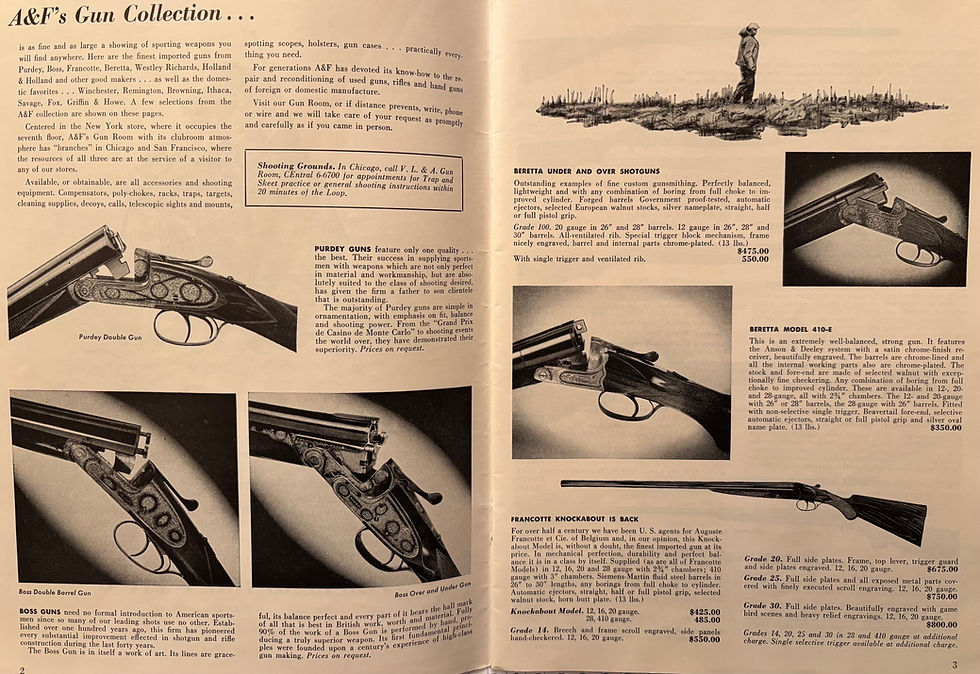
To understand G&H’s place, you must see the full landscape of great importers, gunrooms, and outfitters of the 1920s–1960s. These major players formed the pillars of American high‑grade gun culture.
· Von Lengerke & Detmold (New York) was the most important competitor to A&F before the merger, they imported Mauser, Sauer, Merkel, Greifelt, and other German makers. They sold high-grade doubles and drillings. A&F acquired VL&D in 1929, absorbing their inventory and clientele
· Von Lengerke & Antoine (Chicago) was a sister company to VL&D. They, too, were a major importer of German and Belgian guns. Their Chicago gunroom was the Midwest’s premier sporting shop. A&F acquired them as well.

· Stoeger Arms (New York) was not as elite as A&F, but hugely influential. They produced the catalog that defined American gun importing. They published the famous “Shooter’s Bible.”
· Sloan’s Sporting Goods (Ridgefield, CT & NYC) was the East Coast boutique importer of high-grade English and Continental guns. They sold custom rifles and shotguns. They were known for personal service and elite clientele and where serious collectors shopped quietly.
· Pachmayr Gun Works (Los Angeles) was the West Coast powerhouse in the gun business. If A&F was the East Coast temple, Pachmayr was the West Coast cathedral. They became a cultural hub for Hollywood hunters. They built custom rifles and shotguns and were capable of high-end gunsmithing. They were also importing European sporting arms.
· Holland & Holland (New York Agency) maintained a U.S. presence and sold Royal doubles, best bolt rifles, and bespoke shotguns. They were the only British maker with a consistent American foothold.
· A.H. Fox, Parker, and Winchester Custom Shop (Domestic Elite), while not retailers in the same sense, their custom shops competed directly with G&H for wealthy American sportsmen. These were the American “best guns” of the era - the Fox HE Super Fox, Parker A1 Special, Winchester Model 21 Custom Shop, and Winchester Model 70 Super Grade.
A&F's End and a New Beginning for G&H
The Abercrombie & Fitch era of Griffin & Howe hadn't been just business arrangement — it was the moment when American gun making, British best-gun tradition, and the safari culture of the 20th century fused into a single ecosystem. No other American retailer ever matched that level of integrated expertise.
But the original A&F collapsed financially in the mid‑1970s due to a long, grinding decline. Its assets—name, mailing list, and residual goodwill—were then sold off in bankruptcy.
By the 1960s–70s, middle‑class outdoor retailers (REI, L.L. Bean, Eddie Bauer) undercut A&F with cheaper catalog distribution and lower overhead.
A&F’s elite, high‑inventory model no longer made economic sense. The Madison Avenue flagship became a financial anchor. The 12‑story flagship—with shooting range, fly‑casting pools, trophy rooms, and the gunroom—was incredibly expensive to operate. As sales softened, the building’s overhead became unsustainable.
Americans shifted toward suburban shopping, mass‑market sporting goods, discount retail, and simpler, fashion‑driven outdoor wear while A&F stayed committed to its old identity—elite, clubby, expensive—while the market moved on.
The 1970s recession finished the job. High inflation reduced discretionary spending, and a shrinking luxury‑outdoors market pushed A&F into insolvency. They filed for Chapter 11 in 1976, and the Madison Avenue store closed in 1977. After bankruptcy, Oshman’s Sporting Goods bought the A&F name, the mailing list, and residual brand assets.
Griffin & Howe and Abercrombie & Fitch formally disconnected when A&F went bankrupt. The bankruptcy legally dissolved the relationship. In 1977, Griffin & Howe was sold off as an independent entity. After that point, G&H was no longer part of the A&F corporate structure, gunroom, or brand identity.
Looking back and comparing present day outfitting culture and options, the A&F flagship store was a place like no other. It was a world in itself that defined outfitting a time when safari hunting was glamorized and attracting industrialists and professionals who wanted to be equipped with the right stuff. Image the Griffin & Howe gunroom as the nerve center.
Yes, you can visit a British gun maker or have a safari rifle built by one of our skilled American Custom Gunmakers Guild members. But totally integrated outfitting is behind us. The pure romantic theater of gun buying and outfitting still exists on a micro scale at Griffin & Howe.

Having celebrated its 100th birthday in 2023, Griffin & Howe lives on today under good managerial leadership that refuses to let its heritage wane. It still retains the exclusivity of the golden age of the sporting life in America. And the guns still retain the lines that Seymour Griffin codified as "classic".

And should you visit a mall and see today’s A&F store, don’t look too hard and keep walking. The contrast with the origins of this iconic brand stands as a painful example of how a valued brand can be repurposed and its equity built over years can be shattered.

