_edited.png)


THE BAYAKA (BAKA) PYGMIES

Updated: Jun 4

The Bayaka Pygmies—called Baka in Cameroon, Aka in CAR, and collectively known in Congo as the Forest People—are one of the oldest continuous human cultures on earth. Their ancestry predates the Bantu migrations, the Sahelian kingdoms, and the colonial frontiers.

They can track ghosts. They can sense parts per billion of scent. Each track is a living organism speaking to them. They don't follow "around" an obstacle on the track; they go under or through it. You follow or you will be listless trying to catch a hit of their movement or sound ahead. They will innocently gap you quickly if you are not on withing eyeshot at all times. Their dogs move symbiotically in lock step until the final moment before the strike.

In Pantheon terms, they are a First People, a lineage whose identity is fused to a biome rather than a border. Their homeland is the Ndoki–Sangha rainforest, a cathedral of buttress‑root giants, raffia swamps, and elephant‑cut corridors where human presence is measured in footfall, song, and smoke, not fences.

To the Bayaka, the forest is not a resource. It is a living, sentient elder, a being with moods, warnings, and blessings.


The Forest as a Conscious Entity
Bayaka cosmology is built around Jengi, the great forest spirit. Jengi is not a deity in the Western sense; he is the embodied will of the forest, the intelligence that binds animals, weather, and human fate.
Core cosmological pillars
Jengi — guardian, judge, and mediator between humans and the forest
Luma — the night‑dance where the veil thins and the forest “speaks”
Molimo‑like rituals — awakening the forest after misfortune
Honey rites — offerings to the spirits of the canopy

In Pantheon terms, Jengi is a Biome Sovereign—a spirit‑entity whose domain is ecological balance, not moral purity.
The Bayaka are not “primitive.” They are specialists—masters of a tactical environment that defeats most outsiders.


Operational competencies
Acoustic navigation — reading echoes, bird alarms, and canopy movement
Silent tracking — following duiker, sitatunga, and forest hog through scent and spoor invisible to others
Honey extraction — climbing 30–40 m trees with vine harnesses
Net‑hunting — coordinated group drives requiring perfect timing
Ethnobotany — a pharmacopoeia of hundreds of medicinal plants
Seasonal mobility — shifting camps with rainfall, fruiting cycles, and elephant movement
Their knowledge is non‑written, non‑linear, and situational—a living map carried in memory, song, and ritual.

The Camp as a Moving World
Bayaka society is built around small, mobile camps of 20–40 people. Leadership is fluid. Authority is earned through skill, generosity, and spiritual insight, not lineage.
Social principles
Egalitarianism — no formal chiefs; influence flows from competence
Reciprocity — meat, honey, and medicine circulate freely
Song as governance — disputes resolved through ritualized singing
Initiation — boys and girls undergo forest‑based rites of passage
Their social system is optimized for mobility, resilience, and low‑impact living—a design that has endured for millennia.

Protein is precious and they waste nothing.

They are the Bayaka, the people who walk without disturbing the leaf‑litter, who speak to the forest in chords and echoes, who climb into the canopy to steal honey from the sky.
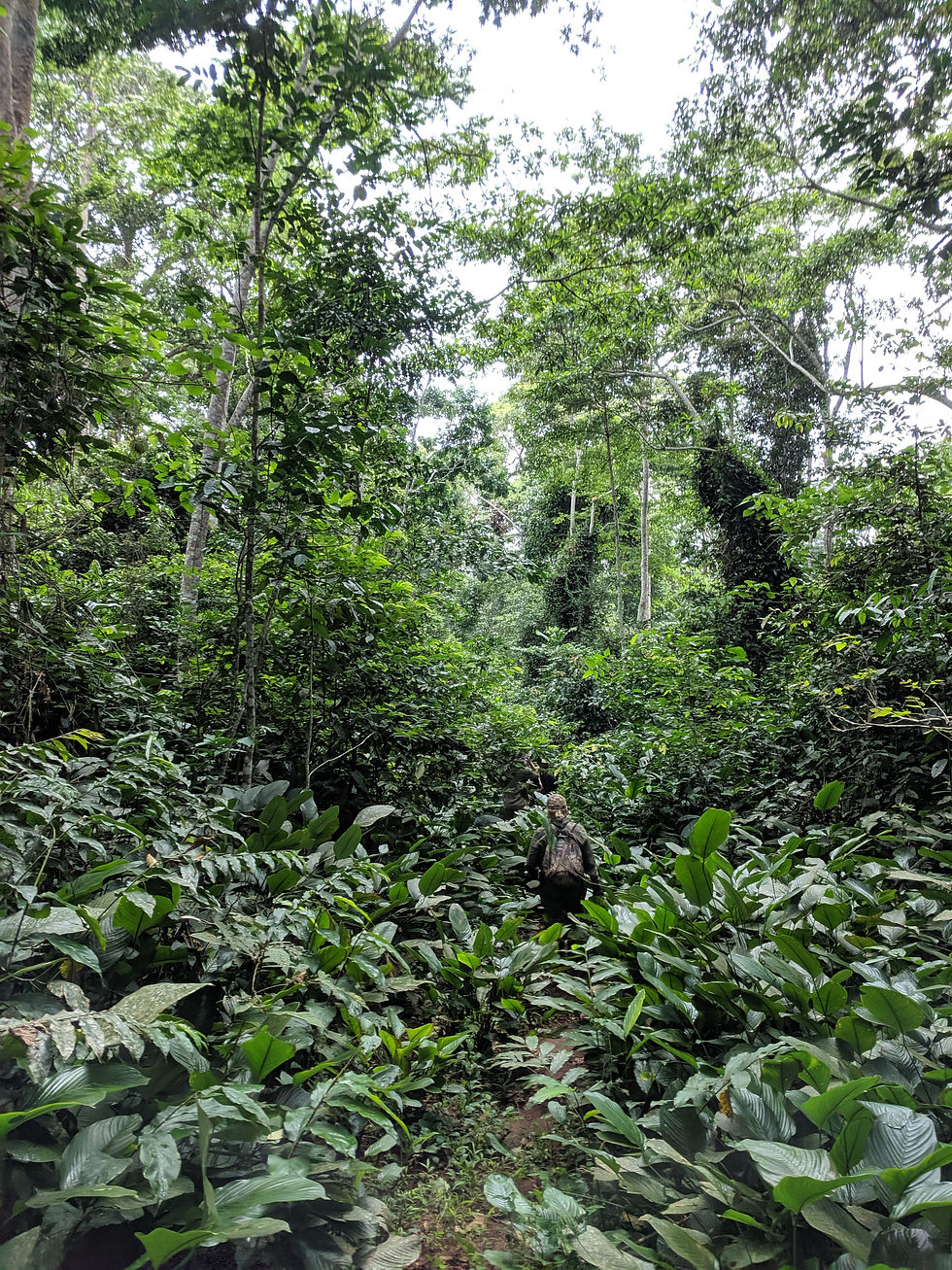


For those who finally hunt the forests of West Africa - for Bongo, Forest Elephant, Forest Sitatunga, Dwarf Forest Buffalo, Red River Hog, Giant Forest Hog, and a host of Duikers - they will realize that "safari" has taken on an entirely new and truer meaning. The Baka do not conquer the forest. They complete it.

