


Trends in Helicopter Utilization for Remote Hunt Support

Updated: Nov 8

Helicopters have proved themselves as a game management tool and are widely deployed by government wildlife departments and private landowners. The Robinson R44 and R66, for example, are as commonly used on large game ranches in South Africa and Texas as Land Cruisers and 4X4s.
What’s changed over the years is the use of helicopters in support of big-game hunting operations. The helicopter's role has expanded to providing access, logistics, safety, and trophy recovery in the world's largest hunting frontiers.
Note that the operative word in a Pantheon context is support – as in supporting the hunt by transporting hunters, supplying camps, and extracting trophies – not hunting from helicopters.
Before I leave the detestable subject of hunting from helicopters, let’s recognize that it exists and in certain regions it's common. Money will buy anything, and for those outfitters offering it and for those hunters interested in it, so be it. But not here. It’s only worth mentioning because it’s easy to get fooled by trophy pictures on social media. If you are perceptive enough to see a pattern of consistently out-sized and colossal trophies taken in certain game lands of the world, you might wonder how that is possible.
One of my roles is to know the deep background and practices of the hunting industry – namely who does what and precisely where so I can advise what to do and what to avoid. When I speck of a curated portfolio of hunting destinations and outfitting partners, what’s there has already been screened and narrowed down to those who do the right thing in an honorable, fair-chase way.
Apart for heli-hog hunting which has its roots in justifiable animal control, a number of bad actors use helicopters to hunt big game, and certain regions of the globe are notorious for this practice. The helicopter can be a standard feature of hunting arrangement or offered as an option, usually on a cost per hour basis. They fly over and set down when they see a monster, and the hunter makes an easy stalk and shoots. If this isn’t your way of doing things, beware and ask lots of questions. That is all that needs to be said. Now we can turn our attention to the legitimate use of helicopters in the hunting world.
Around the world
In North America, particularly in Alaska, and in terms of numbers, Super Cubs and other light aircraft still rule bush flying by a super wide margin. Planes still rule in Africa, too, although the 206, Baron, and King Air are used there.

But in recent years, helicopters have been doing yeoman’s work in Northwest Territories and Yukon. The size of outfitters’ territories there can range well above 9,000 spare miles in area size, and helicopters enable efficient insertion of hunters into remote spike camps and enable complete recovery of downed animals, especially big Alaska-Yukon moose.
I hunted Northwest Territories with pack dogs on a backpack hunts several years ago. The regulation was that we take all consumable meat. After a 2-day walk from our make-shift camp to the spike camp, a helicopter with game department officials aboard visited us. They checked the amount of meat we had packed out and because we had fed some of the raw meat to the deserving dogs, what we had appeared a bit “light” to them. So, they flew to the points of the kills to double checked that we had done the right thing. So, this first-hand story simply illustrates that today’s use of helicopters for trophy extraction helps outfitters adhere to regulations, also.
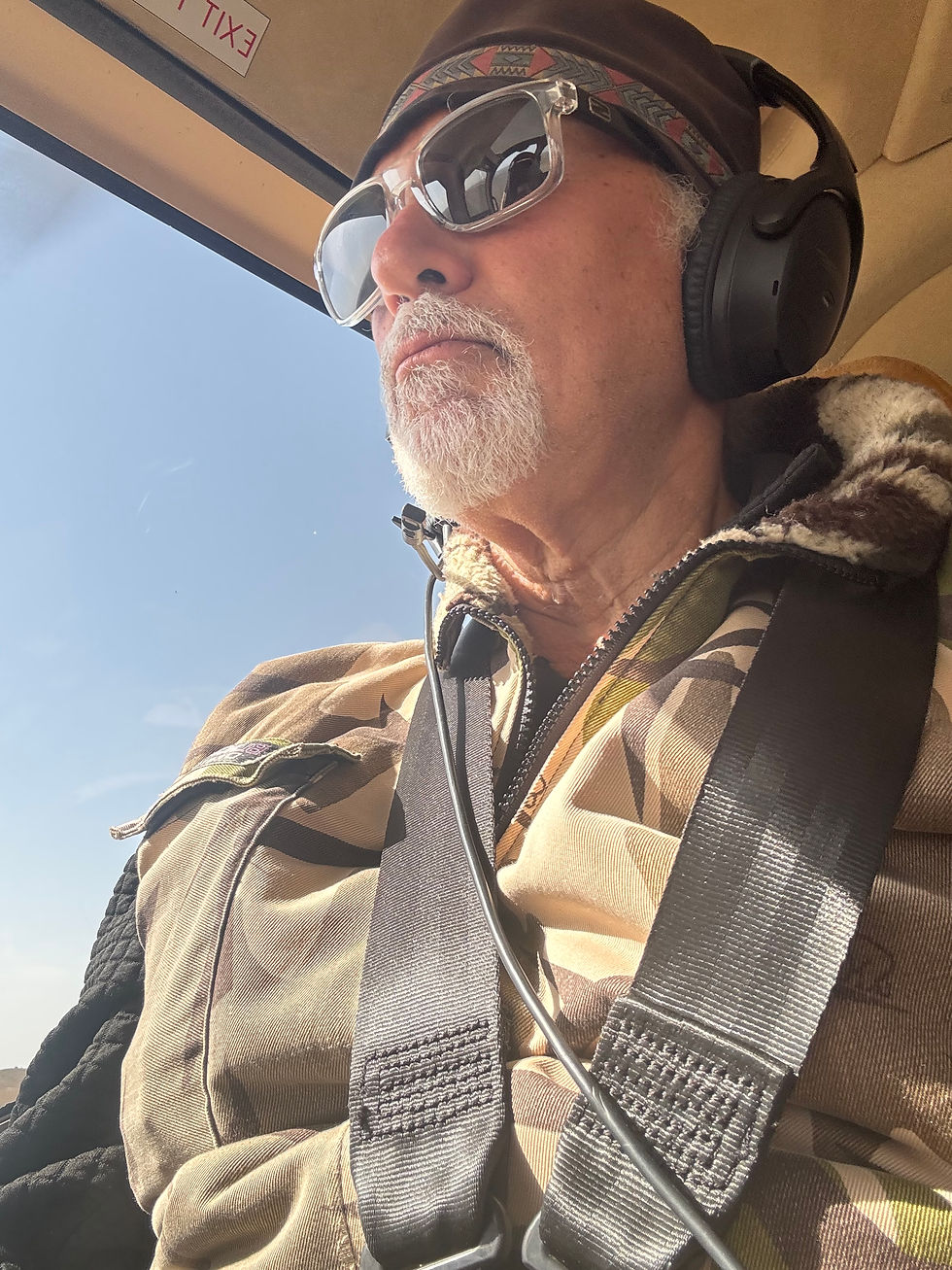
It may seem counterintuitive but the rise in helicopter usage by outfitters is in part attributed to cost and time savings because the alternatives of walking in, packing in, and packing out can be impractical in remote territory. Horses are still a valuable resource in many areas, but they are high maintenance and the total ROI can come into question. Long gone are the 30-day, Jack O’Connor-type pack-in trips.
Today’s destination hunters have obligations to their jobs, business, professions, and families, and the demands on the precious time available adds pressure to the hunt. Hunters say they want to hunt for the experience, but there are boundaries on that from a hunt duration standpoint. Many hunters leave as soon as possible after they have taken their game. There’s no intent to pass judgement that they do this; it’s a simple reflection that time is so precious.

Slicing up and packing out a big moose can consume a couple of days or more depending on distances. The knock-on impact of allocating time for this could limit the opportunity to hunt other game. If the animal is taken late on the hunt extraction time could require a costly extension of the hunt. The main takeaway is that helicopters deliver important transportation and game extraction benefits in some hunting areas.
One major additional benefit is that helicopters allow for more selective hunting. The ability to penetrate deeper into territory means access to game that would otherwise be too costly in terms of time and expense to reach. This allows a more thoughtful harvest of easy to reach populations in a hunting area because it need not be relied on as the only opportunity. Additionally, helicopters can be a safer alternative in certain conditions that challenge fixed wing aircraft.
Australia and New Zealand deserve their own category of use because, unlike Africa's management-centric model or Russia's expedition-logistics model, both countries developed helicopter cultures that became deeply intertwined with hunting, feral animal control, and mountain access.
New Zealand is arguably the most influential helicopter-hunting nation in history. The famous "Helicopter Deer Recovery Era" (roughly 1960s-1980s) transformed both the hunting and aviation industries. Helicopters were used to locate wild red deer, live-capture deer for farming, recover carcasses from alpine terrain, and transport hunters into remote mountain country No other country developed such a large-scale commercial aerial harvest industry. The result was the emergence of highly specialized mountain-flying operators whose expertise later spread worldwide.
Australia is often overlooked because helicopters are not generally associated with trophy hunting there the way they are in Russia or New Zealand. However, Australia may actually generate more hunting-related helicopter flight hours than many traditional hunting destinations due to the scale of feral animal management. Helicopters are extensively used for feral animal control including buffalo management, feral pig control, camel, and donkey reduction programs.
Northern Australia probably represents one of the largest ongoing aerial animal-management operations anywhere in the world. For recreational and international hunters helicopters are used for access to water buffalo hunts in Arnhem Land. The distances involved can be enormous and road access can disappear completely during the wet season. Because Australia has large numbers of cattle stations and utility aviation operations, Robinson helicopters are especially common.
Russia is Ground Zero for helicopter use worldwide
Mainland Russia is vast beyond description, raw and wild. Many of its attractive species are extremely dispersed from civilization and infrastructure, and in most cases, even good roads do not offer the most direct routes even near camps. In that territory, and in the context of the modern hunter’s and Outfitter’s mindset, helicopters are the only reasonable alternative for transportation.

The Mi-8/17 family of helicopters have long been the workhorses of Russian outfitting. They are arguably the most iconic hunting-support helicopters in the world. For decades, the big Mi8 has been the backbone of access to hunts for Kamchatka brown bear, Chukotka moose, and snow sheep.

The Mi-8 is essentially a flying 18-wheeler. Enormous internal volume carries fuel drums, snow machines, camp supplies, boats, ATVs, trophies, camp staff, and hunters. In many hunting areas of Russia, there is simply no substitute. Fixed-wing aircraft may reach a regional settlement, but the Mi-8 moves hunters and camps into the actual concession. From a historical perspective, the Mi-8 probably has delivered more international hunters into remote wilderness than any other helicopter ever built.
Besides Russia, the Mi-8 is also dominant across Pakistan, Kyrgyzstan, Tajikistan, and parts of Kazakhstan for Blue Sheep, Markhor, Mid-Asian ibex, Marco Polo, and Maral hunts. The aircraft's ability to operate above 12,000-15,000 feet and carrying substantial payloads gives it an advantage over many Western helicopters used for expedition logistics.

In the medium utility category, the Bell 206 JetRanger/LongRanger are prevalent in Canada, Alaska, Africa, and New Zealand. They’re probably the most common classic hunting-support turbine helicopter ever operated.

While I would not classify it as a cargo helicopter, the Airbus H125 has earned a reputation as a multi-mission workhorse. They are widely used for domestic purposes, including medical transport, law enforcement, and executive travel. In the hunting world, the H125s are replacing older Bell fleets because of better hot-and-high performance and payload. They are renowned for their mountain hunting maneuverability. They have become a standard.

I have used the H125 for high-mountain expeditions in Uzbekistan and they are amazing. They are well regarded for drop-offs and extraction in the steepest and windiest terrain, and the pilots who fly H125s in that environment are specially trained to leverage its capabilities.
The can land on a gusty mountain peak or precarious ridge as easily as they can on a golf course.
The H125 did great work in Mongolia for us also, flying into and back from camp in the Gobi Desert. The road trip between Ulaanbaatar and our camp would have taken a grueling 14 hours each way over dirt tracks. Yes, it was costly, but worth it to the hunting client.
A Global Hunting Helicopter Typology
If we view helicopter usage from a hunting-consulting perspective, five distinct regional models emerge:
Region | Primary Purpose | Common Aircraft |
Russia & Siberia | Remote expedition access, camp deployment, trophy transport | Mi-8/17, Mi-2 |
Canada & Alaska | Hunter insertion, sheep camps, trophy extraction | Bell 206, Bell 407, H125 |
Central Asia & Mongolia | Mountain hunting logistics | Mi-8/17, H125 |
Southern Africa | Wildlife management, game counts, capture, anti-poaching, hunting support | H125, R44, Bell 206 |
Australia & New Zealand | Mountain access, feral animal management, tahr/chamois/stag logistics | H125, MD500, Bell 206, R44/R66 |
The World's Most Important Hunting Helicopters
If I were building a "Hall of Fame" for helicopters that changed global hunting access, my ranking would be:
Game Changers
Mil Mi-8/17
Opened Siberia, Kamchatka, Chukotka, Mongolia, and Central Asia to modern expedition hunting.
Probably responsible for more remote-camp hunting logistics than any helicopter in history.
Bell 206 JetRanger
The universal hunting helicopter.
Worked everywhere from British Columbia to Namibia to New Zealand.
Airbus H125
The modern king.
Dominates mountain, safari, wildlife-management, and remote-lodge operations worldwide.
Specialist Helicopters
MD500
The mountain hunter's helicopter.
Legendary in New Zealand and among wildlife pilots.
Robinson R44
The great democratizer.
Made helicopter operations economically practical for many ranches and smaller outfitting businesses.
Bell 407
Increasingly the premium North American outfitting aircraft.
Typical Operating Cost Comparison
Aircraft | Approx. Operating Cost per Flight Hour | Typical Hunting Role |
Airbus H125 (AS350 B3e) | ~$1,800-$3,000/hr. all-in depending on utilization | Hunter insertion, pre-hunt scouting, trophy extraction |
Mi-8/Mi-17 | ~$3,000-$6,000+/hr. depending on country, support network, and fuel assumptions | Expedition logistics, camp deployment, fuel and cargo transport, large hunting parties |
At first glance the Mi-8 looks only about 2× more expensive. In reality, that's misleading. The Mi-8's hourly cost may be only 2-3 times higher, yet it may move 5-10 times the payload in real hunting logistics. That is why Kamchatka, Chukotka, Yakutia, and Tajikistan continue using Mi-8s despite their expense.
Acquisition Cost
Current market values vary widely, but a rough comparison is:
Aircraft | Purchase Price |
H125 | ~$3-4 million new |
Mi-8MTV/Mi-17 | Often $8-20+ million depending on configuration and condition |
The acquisition gap is significant, but the larger issue is the support infrastructure required for the Mi-8.
Pantheon Hunters Perspective
If I were building a global hunting-logistics fleet, here's what gets today's nod and the go forward outlook for what will be used for the forseeable future.
H125 - Best all-around hunting helicopter in the world.
Mi-8 - Best expedition hunting helicopter ever built.

In practical terms, an H125 is the machine we charter to move a hunter. A Mi-8 is the machine we charter to move an entire hunting operation. That distinction explains why the H125 dominates globally, while the Mi-8 remains irreplaceable across Russia, Mongolia, and Central Asia despite substantially higher operating costs.
The good news is that many hunts are set up for more than one hunter, and the cost is sharable, either as a separate line item or pre-baked into the base hunt cost. One additional factor to consider when tallying up the total cost of a hunt is that the war between Russia and Ukraine has place a premium on fuel cost. Similarly, oil flows and refineries have been impacted by the stand-off with Iran.
Consequently, the price of fuel changes so dynamically that outfitters cannot quote the cost of the helicopter charter easily up front. I have learned that they need time to negotiate the cost, or in some cases have to give ranges in cost until they get closer to the hunt beginning.
It’s just they way it is today, and we will do our best to help you know how to deal with what are becoming the most indispensable tools of remote mountain hunting logistics – helicopters.

