_edited.png)


Hunting Bongo in Cameroon’s Rain Forest

Updated: Nov 2, 2025

Hunting is a multi-faceted journey of discovery. We experience unique species, human cultures, terrain and local hunting methods. We even discover ourselves as we adapt to the challenges we face. To hunt is to be learning all the time.
Hunting bongo in the rain forest of Cameroon is a test and a learning experience. For many it will redefine safari because conditions and hunting tactics are so diverse from safaris in southern and east Africa.
The rain forest is radically different from the typical African bushveld. Visibility is limited to 5-20 yards. The vegetation and undergrowth is thick and seemingly impenetrable to the point where the average shot taken is 10 yards and rarely as much as 20. You do not need binoculars when hunting the forest! If you decide to scope your rifle, you’ll need just a 1X. A red dot sight or irons might even be better.
Pygmy trackers cut a path in and out with their machetes – all the while tracking and alert for any noise ahead. During the early phase of a stalk, they vigorously hack the bush, but as a track gets hotter, they quietly slice and snip through the vegetation with knives and scissors.

Tracking in the forest can be tedious. A hunter will be stepping over logs and brush, crawling or at least walking in a crouched position for hours on end. It’s simply amazing to see how an animal as big as a bongo or a dwarf forest buffalo will go under a thick bush rather than go around it. The team will follow right on top of the track; if the track goes under, you go under on all fours.
The heat and humidity can be staggering on its own, but it is especially severe when coupled with all the physical exertion required. We averaged about 100F with near 100% humidity daily. It was the rainy season, which is prime time, and this is to be expected. In fact, rain helps a safari. It may rain out on a day of hunting because tracks get washed away. But, there is renewed hope for morning when it’s likely that every track you find is fresh and easier to judge.
One must also be cognizant of ant columns, both the red and black varieties. Considering how the forest floor is shaded by the bush and trees high above it, it’s easy not to see them until it’s too late. Then, it’s a matter of getting them off as they dine happily on you. It’s not fun at all.

Still, the forest is where you find the magnificent bongo and other prized species. Many believe that the limited visibility and keen senses of the dwarf forest buffalo and forest sitatunga make them among the toughest African game to hunt. Of course, the giant forest hog and red river hog also inhabit the forest. But conditions make them opportunity animals in the extreme. Unless you are lucky, you will just get a glimpse of one.

If you are a duiker aficionado, there are the Blue, Bay and Peters duikers to hunt. Not all hunting blocks are open to Yellow back duiker, but Bates Pygmy Antelope is a prize for the persistent collector. Each tracking team has a Pygmy who is skilled at duiker calling. The hunter will sit behind a shallow makeshift curtain with a 12-bore shotgun while he calls. Buckshot is what’s used for these smaller species.

One of the greatest prizes in hunting is the Forest Elephant. You won’t see many in even the largest trophy rooms around the world. A client of ours hunted them rather dedicatedly over a 7-day period while we were there, and he gained a new-found respect for them over larger elephants in the eastern and southern parts of the continent. The hunting team found fresh tracks every morning, but the herd which contained a big bull gaped at them each time they were pursued.
That’s why they are so prized as a hunting trophy. Alongside the Pygmies while tracking bongo, buffalo and sitatunga are their dogs. The dogs are a service to conservation. They put the PH and hunter in a position to avoid shooting females and young bulls.

The dogs do not roam far from them, and are usually quite close. They are indispensable, however, and signal the presence of these species just at the last minute and hopefully enough for the PH and hunter to advance forward, judge quickly, and shoot. After trying to be as silent as possible on the stalk, all hell breaks loose when you hear one of the dogs bark. Then it’s a matter of running in the direction of the noise which gets even louder as the other dogs join together and attempt to bay the animal long enough for the hunter to shoot.
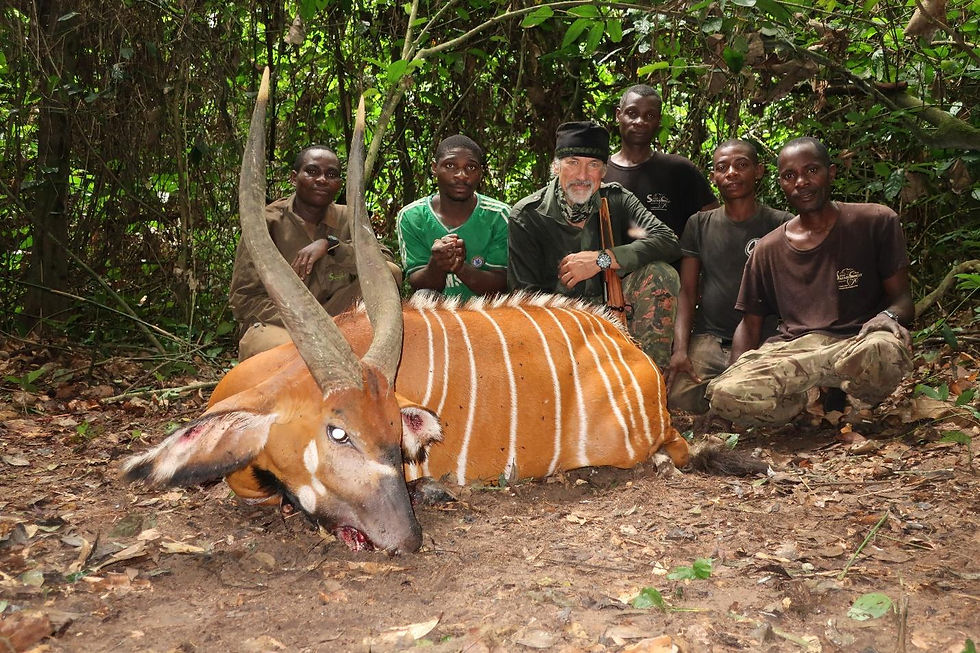
It is said that a hunter does not “take” from the forest. Rather, the forest decides if it will “give up” something to the hunter. This is a very good way to think about hunting the forest, aligning your expectations and preparing yourself for it. All things considered forest hunting is real safari hunting.
Contact us today to start planning your next expedition!
