_edited.png)


Real Men I

Updated: Jan 10
A big game hunter stands at hope’s ravine and then plunges into the unknown. Hunting is a primal journey of personal discovery; it helps us understand who we are, our limits and our level of commitment. It can trigger the highest emotional highs and lowest lows in rapid alternating microbursts, and it can also make a body scream and wish it were somewhere else when it realizes it is not physically fit for a challenge.
But if truth be told well and if there is such a thing as hunter’s guilt, it is that we often succeed through others. Hunting consultants. agents, outfitters, guides, PHs, and camp staff make our successes possible. I should mention horses, Land Cruisers, ATVs, mules, Super Cubs, pick-up trucks and mokoros just so they do not feel slighted. But we will save praise for them in a future installment.
This begins a series of real-life stories honoring some exceptional men who were extraordinarily selfless, relentless, skilled, and strong as they performed their duties in the remotest parts of the globe. These are stories about new brothers who made us better hunters. Our trophies really belong to them.

Central African Republic
This might feel like you're reading about ancient history - a destination void of present-day hunting opportunity according to media headlines and advisories from the US Department of State about the security situation. Like most things in life, painting with a broad brush eliminates understand and opportunity. There are good hunting opportunities in C.A.R. today if you know where to look. Just like a big city anywhere in the world, there are good neighborhoods and bad. There still are thriving game populations and elite outfitters operating without issue in C.A.R.
But this is not our main topic here. This post admittedly reflects back in time, but recognizing the soul and sweat of some elite men should never expire. So, here's the story.
Most hunting blocks in this wild, forsaken part of West Africa are only accessible by air charter from the capital city of Bangui. There are no “Toyota safaris” in C.A.R. because they are impossible. Hunting blocks that remain safe and active are relatively underdeveloped compared to those in other African countries. Each vehicle track has to be cut by hand before the hunting season begin, and camp staffs usually hack out just a couple of main tracks from one end of the concession to the other end: one in a north south direction, and the other east-west. That’s it.
Finding and following fresh spoor is how hunting is done there. Precious few if any trophies ever come easy, and it always feels better that way. For those who prefer to earn their trophies by hunting them, they will get all the earning they can stand in C.A.R.

Before a hunter ever sees a game animal, mopane flies, tens of millions of them, will meet and greet them before swarming and harassing incessantly. They are mortal enemies that will not quit and cannot be stopped. Head nets are mandatory fixtures, but they are marginally effective at best. These tiny bees will find every orifice you own and take up residence without asking permission.
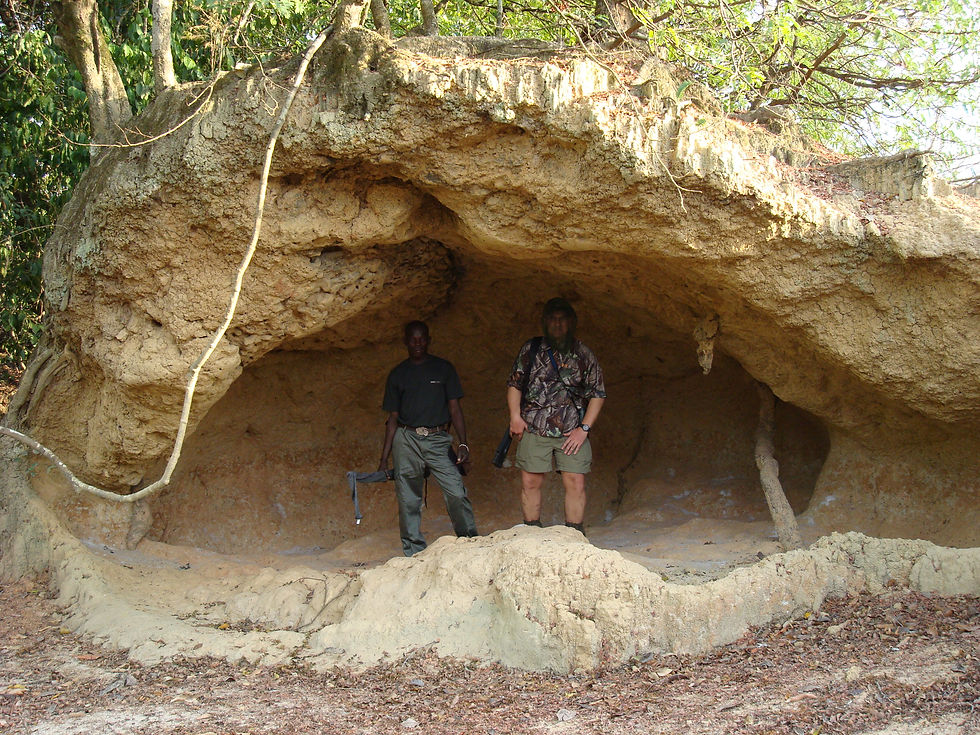
Their constant buzzing will drive a billy goat dizzy. Count on two weeks of this or more. Full-time. Blurry white imperfections marring photographs are painful reminders that they like to land on camera lenses, too. About the only thing that fends them off temporarily is thick smoke. You would have to stand on the edge of a billowing fire to get some relief. In 100-degree heat, you begin to debate what is the lesser of two evils: continuing on or cleaning your ears with a .45.

You can take it to the bank when you hear that the Lord Derby eland (a.k.a. Giant Eland) is one of the world’s greatest game animals. This grand 2,000-pound beast stands 6 feet at the shoulder and yet it can easily leap completely over one of its compadres in a fluid motion from a standing start. If spooked, they can gap a hunting team so fast that it is usually better to call it a day or find another herd to track.
Their thick black spiral horns at 50+ inches around the spiral, their tan-orange body marked with white stripes, and signature dark ruff make them a most imposing creature worth all the effort. Andre Roux, was a dear friend and veteran PH of C.A.R. He was a journeyman PH who saw action in every major hunting country. He could do it all, but C.A.R. was “his turf” for 25 years.
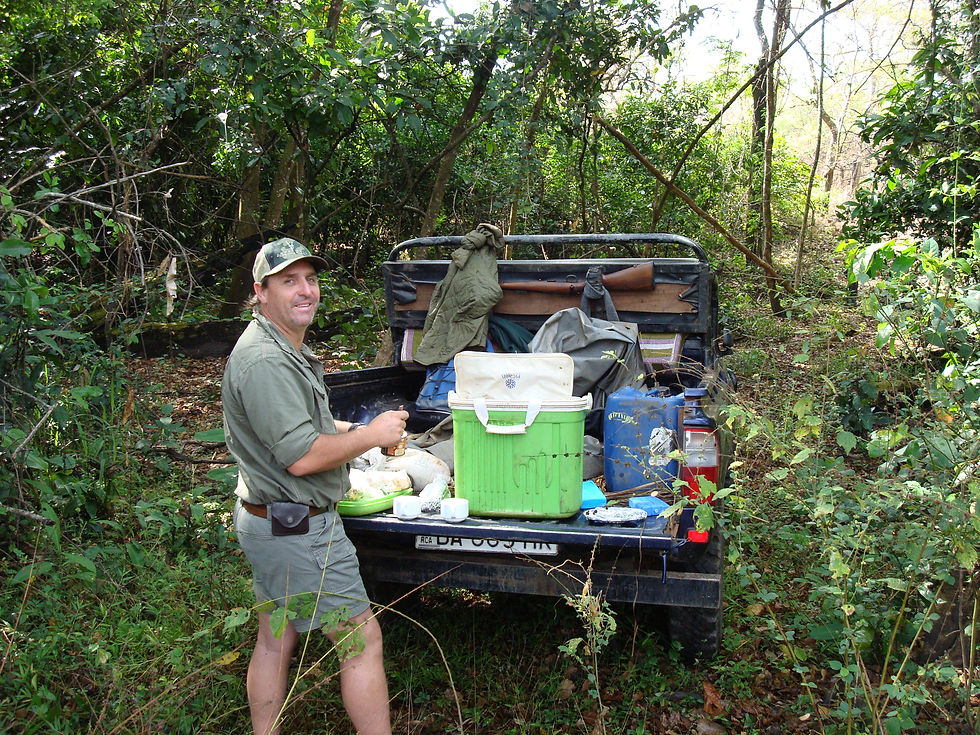
We had discussed hunting Lord Derby for years, and the dream hit home when I finally saw his smiling face at the airstrip. A most likeable guy and gun nut, Andre was one of the rare few who knew what a .416 Taylor was, and he had much admiration for vintage caliber greats like the .318 Westley Richards and .333 Jeffery. He had to be a brother from another mother because I admired and had used both of those offbeat but effective calibers extensively.
I thought I knew Andre quite well but being in the field with him made me realize what a truly exceptional hunter he was. He was as good as our trackers, Christophe and Robson, who themselves were as good as any of the legendary Bushmen trackers of Botswana that I had experienced. That is saying something provocative about these three men. They were the good hands people of African hunting.

One of Africa’s rarest trophies is the Giant Forest Hog. I know a hunter-collector who took 9 trips to Africa before he was successful in taking one. They are by no means endangered; they simply inhabit limited territory, and C.A.R. had some isolated pockets of them. Tank-like in build and ugly fit this beast, but I appreciated its importance as a hunting trophy. I was lucky. Mine came late on the 3rd day after a miraculous stalk in thick grass led by Andre.
The magnificent old eland bull that I took fell to a .375 H&H with much elation on the 5th day of the safari. Christophe and Robson had been on point since dawn when we caught a momentary flash of movement ahead of us. The bull had turned and was now standing head-on inquisitively at 75 yards. The Swift A-Frame traveled impressively through the full length of the body and lodged under the skin on the rump. Walking up on him was something else. Handshakes and back slapping were offset by moments of silence and reverence as that grand creature laid there in all of its glory. I realized that I would have never got him on my own.

We built a fire as the team started skinning. Meat is gold in Africa, and no protein is ever wasted. Only the rumen left behind marked the spot of a downed game animal.
Skinning an animal that size was a mission. It was made a bit more pleasant with some salt and pepper retrieved from Andre’s daypack to flavor the tenderloins that we threw into the burning embers. We scraped off the charcoal and dove into something more succulent than what they serve at The Capital Grill.

We cut 6-foot poles that would be balanced on the shoulder with outsized hunks of meat and bone tethered at each end. Guys that weighed 120-140 pounds soaking wet carried the equivalent of their body weight out of the bush for miles. Imagine one of these slender, zero-body-fat hunting athletes literally doing a slow jog with that much weight on the point of their shoulder. But this meant payday to them, and they were happy regardless of how heavy the load was and how far we were from the Land Cruiser. Tough hombres.

We reached the vehicle by dark, loaded up the meat, and decorated it with branches as a celebratory symbol of the team’s crowning achievement. I honestly feel there is no group of humankind happier than a victorious safari team. The volume of their songs accompanied by non-stop beeping of the Land Cruiser horn increased about two miles from camp. As we approached, we were greeted by the joyous dancing staff carrying torches that lit up the darkness. To realize that the work of all these guys was dedicated solely to a hunter's dream was humbling. They genuinely regarded hunting success as their success. The party lasted well into the night.
Attention shifted to Western Roan the next day. Any variant of roan is a treasure, and like the Lord Derby, they must be hunted. Bulls often travel solo or in small bands, and they can perform disappearing acts so fast that you never have time to raise your binoculars let alone shoulder your rifle. Glimpses of their back ends are commonplace.
With just 2 days left, we surprisingly cut the spoor of a herd of roan. They had been feeding the night before and Christophe isolated the tracks of a lone bull among the thousands of impressions the herd had left. With bodies bent and heads just a couple of feet above the ground, they sorted out that lone bull like a pair of bloodhounds, stopping to confer regularly with each other on what was what in French.
We had been tracking for over three hours and yet were still no more than 200 yards in a straight line from where we had cut the track with the Land Cruiser. The bull had been milling around aimlessly with the others, but Christophe finally found where it had broken out and left the herd behind. Our adrenaline kicked in. The march was on.
The path that the bull took found us crossing in and out of two radically different ecosystems. Sun-scorched, open savannas were occasionally interrupted by small shallow streams lined with high trees and impenetrable green undergrowth. These cool veins of water flanked by lush vegetation offered cover for several species including an occasional shy bongo.
There are also diamonds below the water’s surface. Many of the camp staff would venture back into the bush during the off season as bandit prospectors and sell what they could dredge up by hand to traders in Bangui. Not much has changed regarding Africa’s culture of trading.
We had crossed three streams by early afternoon and noticed that the bull was slowing down to feed, an encouraging sign that we had not spooked him while hot on his trail. We had closed the gap unknowingly as we approached the fourth stream. Our hearts sank on hearing the pounding of heavy hooves and branches snapping as the bull broke out into the savanna on the opposite side. We still had not seen him. Had we lost him?
Christophe continued in the lead with an encouraging smile that said, “I got this”. An hour later, he came to a stone-cold stop. With a naked eye he made out the swishing tail on the bull as it walked slowly about 300 yards ahead. Fearful of the wind changing, we crawled to around 200 yards and waited for him to do a quarter turn. Again, the .375 lived up to its reputation.

This was no ordinary trophy; it was an old, worn down, Top 10 animal at that time. You could feel the tension drain out of us as dopamine took over. We had just experienced one of the finest tracking jobs and stalks imaginable. Christophe’s arresting smile told the story without words. We heaped congratulations on him.

To hunt with the absolute best of men, real men who never complain, who give it their all so willingly and naturally, is one of life’s gifts and lessons. Role models in their own right, one wishes that everyone in life would give like they do.

